
December 2025 was one of those months where I just sat back and thought… okay, this actually works.
My blogging business brought in $60,545 in a single month, and I want to break it down in a way that actually shows what’s going on behind the scenes.
And I’m not sharing this to brag. I’m sharing it because I remember exactly what it felt like being on the other side of this, wondering if blogging was even worth it, if people actually make money from it these days, and whether it could ever replace my day job.
Reading income reports were the kind of posts that kept me going, especially during the times when things weren’t working the way I expected. They made me think, if someone out there can do this, then it’s possible… and I can do it too!
Because I know how it feels to be in that phase where you’re posting, pinning, trying things, and wondering if it’s ever going to turn into real income.
It does. But it also doesn’t happen by accident.
The Numbers
Income:
I made almost all of that income from one site, UrbanMamaz.
- $53,454 from displaying ads
- $5,611 from affiliates
- $840 from Facebook monetization
- $11 from POD (which honestly tells you everything about how little I focus on that)
Total: $59,916 from UrbanMamaz, plus $629 from my newer site that I launched a few months ago.
Expenses:
My total expenses for December were $3,847.
And if I’m being honest, this business is pretty lean for the amount it generates. My monthly expenses don’t really change much unless I buy something one-off, like a new laptop or something similar.
I’m not spending money on anything complicated. Most of my expenses go toward tools that help me move faster, stay consistent, and handle volume.
Here’s what that actually looks like:
- Content writers – $1500
- Virtual assistants – $600
- Ahrefs $29 → I use these to validate ideas. I’m not doing deep SEO work, I just want to know if a topic is worth writing and has traffic potential.
- Tailwind $17.99 (annual plan) → runs Pinterest in the background so I don’t have to think about it daily.
- Post Planner $37→ a big part of my Facebook traffic. Helps me stay consistent and double down on what works. And they hay the option to add link in first comment when you schedule.
- Buffer $10 (annual plan)→ for everything else that doesn’t need a full system.
- Canva $10 (annual plan) → this is where most of my visuals come from. I use templates so everything is fast and repeatable.
- Adobe Photoshop $34.99 → for more custom designs when I want something to stand out.
- MidJourney $60 → when I need specific visuals I can’t find anywhere else.
- Unsplash + DepositPhotos $30 → quick free and paid images when I don’t need anything custom.
- ChatGPT + Claude $40 → this is mostly about speed. Ideas, refreshing content, rewriting. Not replacing thinking or 100% writing, just helping me execute faster.
- MailerLite → $39 runs my email list, automations, and newsletters. Simple and does the job.
- Descript $24 → for video editing when I need it.
- Gmail (Business Email) $18 → everything runs through it.
- Hosting (Rocket.net + Bluehost) $75 → this is where my sites live. Performance matters more than people think once traffic grows, and I’ve had a really good experience with Rocket.net.
- The rest goes to general office expenses.
Total Income: $60,545
Expenses: $3,847
Net Profit: ~$56,698
What Worked for Me This Month
1. Q4 + Seasonal Content (this is the biggest one)
The biggest factor here is honestly timing.
December is Q4, which means advertisers are spending more, RPMs go up, and every pageview is simply worth more. So the same traffic you might get in a random month suddenly becomes way more valuable.
That’s why this month looks very different from the rest of the year.
And this isn’t something you “fix” in December. This is something you prepare for months in advance with seasonal content. If you’re in lifestyle, food, parenting, DIY, or anything seasonal, this is the moment where everything pays off.
2. Facebook finally clicked for me
The second big thing for me was Facebook.
This is the most satisfying part because it didn’t happen overnight.
I’ve been experimenting with Facebook for over a year. Testing different types of posts, trying to understand what actually gets clicks, what people engage with, what doesn’t work… and for a long time, it felt like nothing was really taking off.
And then a few months before December, it finally clicked.
Traffic started growing, posts started picking up momentum, and by December it was at its peak.
It almost doubled my income.
That’s something I think a lot of people don’t realize. When something “works,” it usually comes after a long period where it didn’t.
And the best part? I got excepted to Facebook content monetization, that add extra income on top of my blogging income! This means that Facebook shares with me the revenue from ads they place next to my content that leads to my blog posts.
3. Pinterest stayed stable (which is a win right now)
Pinterest stayed pretty much the same, compared to the same time last year.
And right now, that’s actually really good news.
I’ve been hearing from a lot of bloggers about traffic drops, especially with everything that’s been happening lately with AI. Pinterest is flooded with AI-generated images right now, and it’s getting harder to stand out.
So for me, the fact that my traffic stayed stable is a win.
But what I did change wasn’t volume. I didn’t double the number of pins I post every day.
What I focused on was improving the visuals.
Over the years, I’ve become way more picky about the images I use. Even though I have VAs helping me schedule and manage my Pinterest account, I still check every single pin before it goes live.
I don’t just approve things blindly.
If something doesn’t look good, it doesn’t get posted.
Because at this point, I know that on Pinterest, the visual is everything. If it doesn’t stop the scroll, nothing else matters.
5. Using AI, but not relying on it
Yes, I use AI. At first, I was honestly a bit hesitant because I didn’t want to risk something I’ve built for years. Especially my Pinterest account.
So I didn’t and don’t spam it. I don’t generate hundreds of images and push them out.
I use it in a more controlled way:
- I use it to express unique style or ideas
- I use it when I can’t find good images in stock photo sites that I need
- I still use regular stock photos though – this is very important because you want your blog to feel real
- I still take my own photos – super important!
- I still edit everything before publishing
- and I still make sure it matches my style and actually looks real (no people with three legs or anything like that hahaha).
I see it as a tool, not a replacement.
6. Consistency over time (this is what makes everything work)
And if I’m zooming out for a second, the biggest thing behind all of this is consistency.
Nothing here is a “one-month strategy.”
Most of the content that made money in December wasn’t published in December. It was content I created months ago, sometimes even years earlier, that just kept getting traffic.
The systems were already in place.
December is just the month where everything compounds at the same time.
That’s really what this month was for me.
Not luck. Not one viral post.
Just everything I’ve been building working together.
UrbanMamaz Traffic Breakdown
If there’s one thing to understand here, it’s this:
This is an ad-driven business.
Most of the money didn’t come from selling anything. It came from traffic.
UrbanMamaz did about 1,040,000 pageviews in December.
- Pinterest: ~500K
- Facebook: ~400K
- Google + email + direct: ~140K
So almost 90% of my traffic came from Pinterest and Facebook.
That’s not random. That’s intentional.
I built the site for high-volume social traffic. Content that people want to click, save, and share.
And honestly, this is one of the biggest mindset shifts I had:
I stopped trying to “rank” every post and started thinking, “Would someone actually click this on Pinterest or Facebook?”
That changed everything.
But this wasn’t always obvious to me.
What I Realized After Buying a $1,000 Course
About 3 years ago, I bought a blogging course for around $1,000.
At that point, I had already started investing in a few courses, and most of them were good.
But this one focused on building a blog around selling your own product which I realized after buying the course.
And to be honest, that strategy is right. It’s more profitable and you can usually make money faster that way.
But at that time I was focused on something different, and that course helped me understand that clearly.
After selling jewelry, running a digital sticker shop on Etsy, and testing products on my site, I knew I didn’t want to force another product just for the sake of it.
I wanted to build something where the product was simply… content.
So when I reached out their support asking how to grow an ad-based business, they couldn’t really help me, because that wasn’t their model.
And that’s when it clicked.
I was trying to build something different.
I was looking at big content sites getting millions of pageviews and thinking, this is what I want to build.
Not because it’s easier, but because it fit me better.
Now, hitting 1 million pageviews in a single month, I can say this:
It’s possible.
But it takes time to figure out the path that actually fits you.
And this isn’t the end. It’s just the beginning.
Because once you get to this level, you understand what works, and from there you can layer everything else on top, products, email, sponsorships, all of it.
That’s also why I decided to finally put my strategy into something structured.
Not just for people who want to sell products, but also for anyone who wants to build a blog that makes money from ads, affiliates, sponsorships, or a mix of all.
Because that’s the part I felt was missing. As a blogger you can make money in so many ways – this can be really confusing but on the other side – this can help you diversify or go with the options that best fit you.
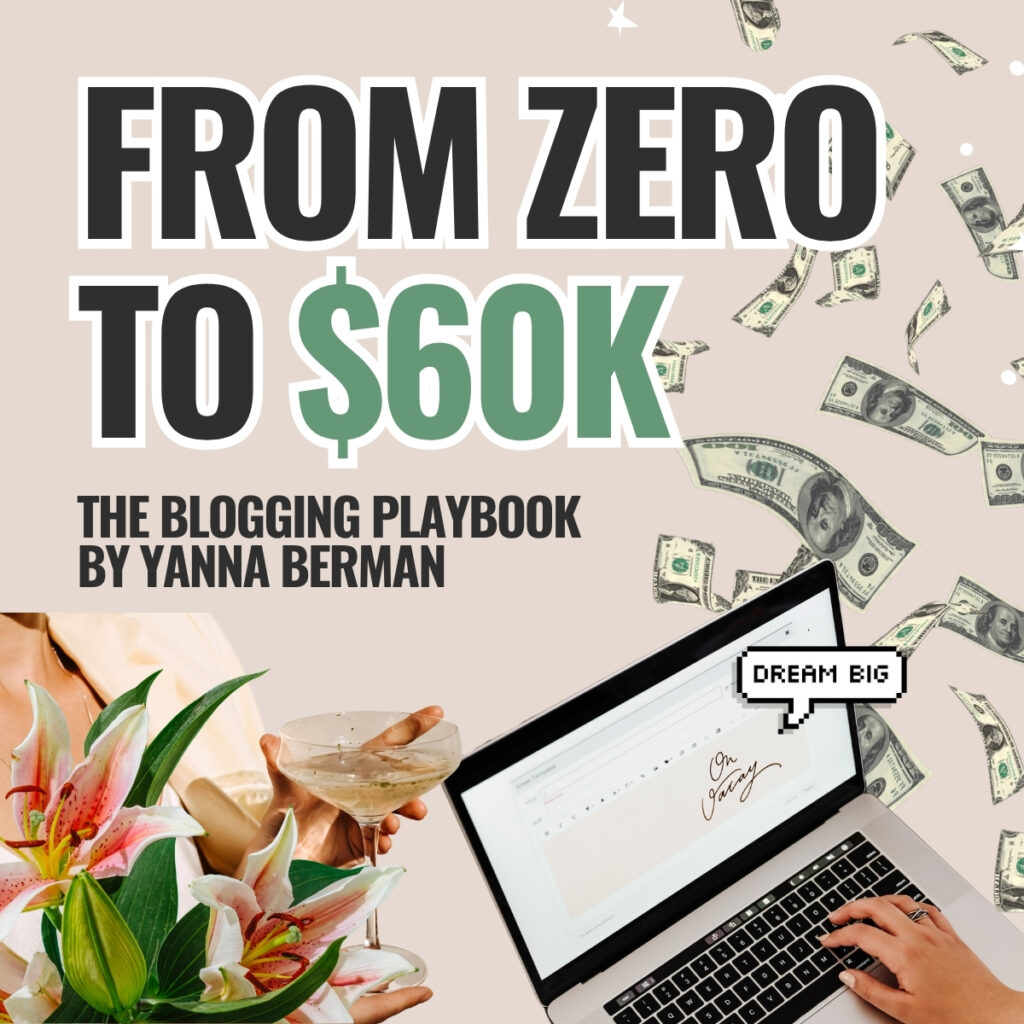
So I created a full playbook breaking down exactly how I went from zero to $60K/month with you can check here.
Diversification Is Not Optional
This is something I learned the hard way.
Diversification is not optional.
I’ve had Pinterest drops. I’ve had Facebook fluctuations. And every time it happens, you realize how risky it is to rely on just one platform.
If all my traffic came from one source, this business would be stressful.
But having multiple traffic sources makes it much more stable.
If one drops, the others can carry you.
And that’s exactly why one of my main goals this year is to keep diversifying both my traffic and my income.
Not just more platforms, but also more reliable sources I actually control, like email, products, and other revenue streams.
What’s Next?
Lately, especially with the beginning of 2026 and hitting these milestones, I’ve been thinking a lot about one question:
what’s next?
Not just how to grow this blog, but what it actually takes to build a $100M business.
How do I turn this into a real media company? How do I expand my team? How do I build something people actually recognize as a brand?
That’s where my head has been lately.
Thinking Bigger Than Traffic
One thing I started digging into is what actually makes some sites worth millions.
You see sites getting sold for $30M, $50M, even hundreds of millions, and it makes you think, what’s the difference? What makes those sites valuable?
And what I realized is this:
it’s not just traffic.
Getting millions of pageviews a month is great, but no one is paying $30M just for pageviews.
Because at the end of the day, you don’t fully own that audience. Pinterest, Facebook, or Google can suddenly change their algorithm and stop sending you traffic, and you are gone.
And unlike influencers, where people follow a person, with content sites, most readers don’t even know who’s behind the site.
And that’s not a bad thing. It’s just different.
What Actually Makes a Site Valuable
When I looked deeper, there were a few things those bigger sites had in common.
They weren’t just content sites.
One thing many of those bigger sites had in common was that they usually had something beyond traffic, either products they sell, a strong email list, or some kind of tech, SaaS, or tool they developed. This is where you fully control your business.
That’s where the real value is.
Where I’m Heading Next
That’s exactly what I’m planning to double down on now.
Not just traffic, but selling my own products and investing much more into my email list.
Because if the goal is to build something big, something closer to a real media business, those are the pieces that matter.
And yes… why $100M?
Because I’ve seen a similar business sold for those kinds of numbers. Which for me means that it’s possible 🙂
And honestly, I like having a big number to aim for. It gives me something clear to work toward.
From here, the rest of the strategy still builds on what’s already working.
Social traffic at scale is still the foundation.
Pinterest and Facebook drove almost a million pageviews this month, and when that kind of volume hits during Q4, that’s where the big income comes from.
But now it’s about building on top of that in a smarter way.
If you want to learn more about my strategy, I share all of this in my playbook I mentioned earlier.
What I’d Focus On If I Started Today
If I’m being completely honest…
I would start the same way again.
Because this is how I learned everything I know today.
But there’s one thing I would think about much earlier.
Do you have a product you want to sell?
Because that changes everything, and again, YES IT’S A FASTER WAY to make money blogging. You can start monetizing right away and build your content around that.
But if the answer is no, that’s completely fine too – not knowing what you REALLY want to sell.
That’s exactly where I was and that’s not the end of the world!
And this is something I wish more people understood lol
There Are Two Valid Paths
This business works. It works really well.
But it’s not the fastest way to make money when you don’t have a product.
It takes time.
You’re publishing, testing, waiting for things to hit, dealing with traffic fluctuations… and for a while, the money just isn’t there yet.
So you need to be honest with yourself.
If you need money fast, focus on selling something.
If you have time, or a day job, you can build this slowly.
Focus on traffic, monetize with ads, and figure out what you actually want to sell along the way.
And honestly, your audience will tell you what they want. You just need to read their comments!
Do I think I should have started differently?
Maybe.
But I also know I wouldn’t be here without this path.
Because building this forced me to understand what people actually click on, get really good at content, and build systems that scale.
And that’s the foundation for everything I’m doing now.
The Bigger Picture
For me, December didn’t feel like luck. It felt like everything I’ve been building finally lining up at the same time.
Content I published months ago. Traffic systems I’ve been refining. Monetization that was already in place.
All compounding at once.
That’s really how this works.
Not one viral moment. Not one perfect strategy. It’s testing, learning, pivoting when needed, and optimizing.
Just stacking the right things over time until it clicks.
So if you want to see exactly how I built this step by step, I break it all down inside my strategy playbook here.
And if you want to get more updates and interesting insights about my journey and generally about inspiring stories of other people who make money online – subscribe to my newsletter!
And remember, it’s never too late to start and everything you can imagine is possible!
Happy blogging!


